Rubber Stamp rides again

RUBBER STAMP RIDES AGAIN. Apparently Minnetrista council members are fine voting to update city policy without knowing what the updates are. In a 4-1 vote last night that’s exactly what happened. rubber stampUnder the consent agenda at our council meeting was an item updating the city’s Post-Issuance Debt Compliance Policy. In the policy/backgrounder (pg 30) provided there was nothing summarizing what was being updated and council was not given the changes in any form where we could see what, exactly, was being changed. Call me crazy but I said I couldn’t vote to approve updates without knowing what they are. The Mayor felt otherwise and indicated that as long as the finance director and city attorney had read it, that should be enough for council. I was cut off when I attempted to remind the council that approving city policy is the council’s job, not the job of city staff. Apparently not in Minnetrista.

Minnetrista campaign violations update

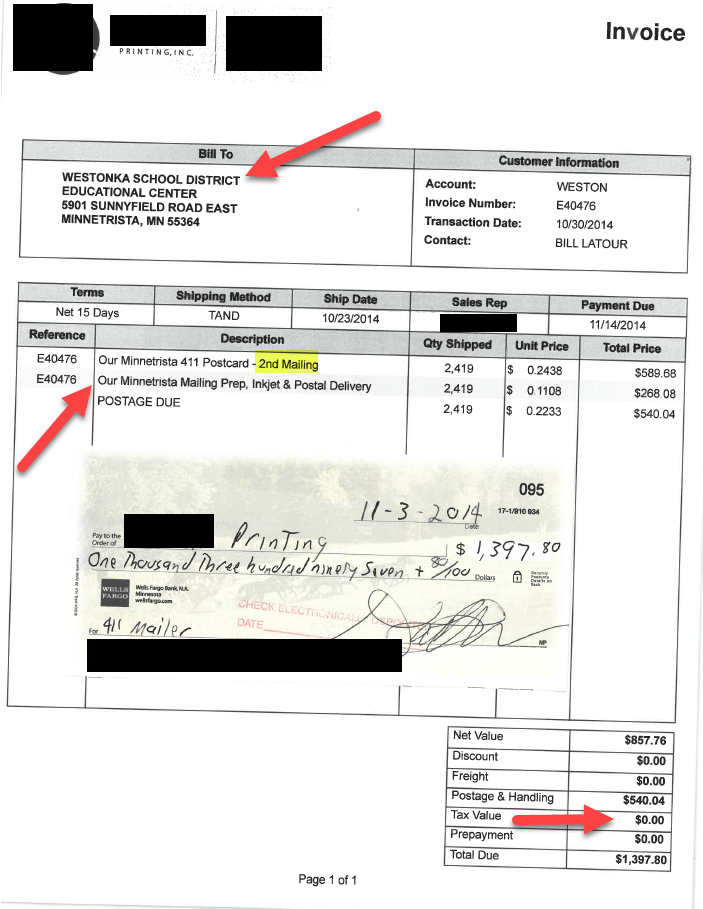
MINNETRISTA CAMPAIGN VIOLATIONS UPDATE: No judgement as of yet but Respondents in the case, which include Minnetrista Mayor Lisa Whalen, two present council members (Mortenson/Tschumperlin), one past council member (Thoele) and leaders of the “Our Minnetrista” organization, have admitted that contributions recorded as coming from individuals actually came from “Our Minnetrista” and were deposited into “Our Minnetrista” accounts, not accounts belonging to the candidates themselves as their disclosure reports showed. Subpoenaed bank records also showed many of the contributions to “Our Minnetrista” far exceeded the $600 statutory contribution limit. The scheme involved taking contributions that exceeded the limit and dividing them up among the candidates and recording them as multiple smaller contributions.

Bar Chart comparison 2014-2018 Contributions and ExpendituresThe scheme managed to go undetected for years until a banking regulation required that checking accounts opened under an assumed name had to be registered with the Secretary of State’s office. The discovery of the registration of “Our Minnetrista” as an assumed name led, among other findings, to the eventual filing of the complaint.

Both Complainant and Respondents have requested a summary disposition in the case. The Office of Administrative Hearings is reviewing the case but has not yet ruled.

Media contacts: https://mn.gov/oah/media/media-contacts.jsp (OAH case# 71-0325-35774)

GreenStep Cities Red Flags

GREENSTEP CITIES RED FLAGS: Mayor Whalen invited a representative from the GreenStep Cities program to address the city council last August. Enticed by the lure of recognition and their seemingly benevolent mission, “Minnesota GreenStep Cities is a voluntary challenge, assistance and recognition program to help cities achieve their sustainability and quality-of-life goals,” it gained legs with staff and was advocated again at the city council’s strategy meeting in February.

When the GreenStep representative was asked last August about where their funding came from they said it was primarily nonprofits, foundations, and grants. What they failed to disclose is they have two major funders, one of which is the Met Council. And we all know the Met Council’s allegiance to local government autonomy.
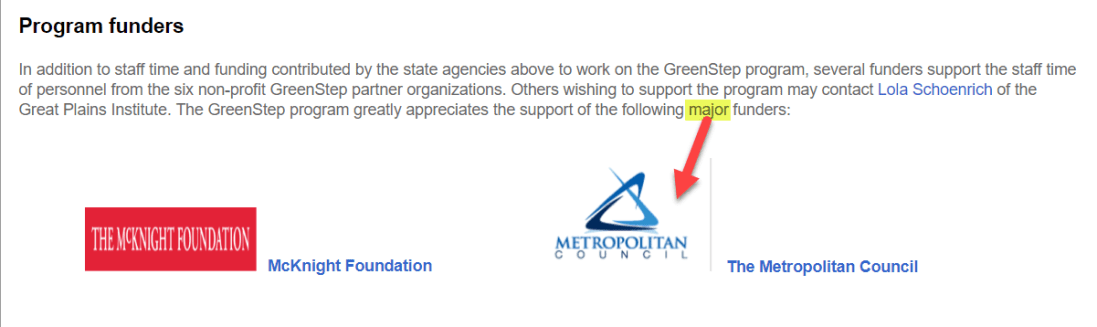
GreenStep Met CouncilRed flag number one: Not being transparent when asked a direct question about funding sources.

In conversations over the weekend I learned from one of our state legislators that the GreenStep Cities program is “Repackaged from what was formerly known as Agenda 21 (for the 21st Century) GreenStep appears to be an obfuscated friendlier name for the same thing.”

Those unfamiliar with the United Nations Agenda 21 need only know it didn’t receive a warm welcome in the United States, with states passing resolutions condemning it and one even passed legislation prohibiting government involvement in the program.

Red flag number two: Changing the organization name when it’s reputation is exposed as undermining federal, state, and local autonomy.

The GreenStep Steering Committee is comprised of representatives from several nonprofits that are all climate change evangelists working together with the University of Minnesota, League of MN Cities, and various state agencies.

GreenStep Steering CommitteeRed flag number three: Human caused climate change is a controversial topic and there is no diversity represented on the steering committee.

This is not a program that will benefit the Minnetrista electorate. In fact, the sample ordinances they provide to cities appear to be designed for more government control over building regulations and private property use.

No award from the League of MN Cities is worth this.


What is the REAL cost of having a gun range?

WHAT IS THE REAL COST OF HAVING A GUN RANGE? We all know the saying “There’s no such thing as a free horse.” Vet bills, tack, shoeing and boarding costs will far outweigh the savings of that “free” horse.

arms blur close up firing
Firing ranges do not support themselves with user fees

The City of Minnetrista needs to understand there’s no such thing as a free gun range. Despite the possibility of receiving a grant for the initial build-out, the ongoing operational costs for staffing and maintaining a firing range will far eclipse the initial investment to construct it.

Minnetrista residents were clear when they answered the community survey question, “Should the City of Minnetrista finish the gun range?,” that they did not want taxpayer dollars spent on it. Only 5% supported using tax dollars. 25% indicated support if outside money would pay for it. 62% indicated support if user fees would cover the cost.

What they weren’t told as part of the survey is that firing ranges do not support themselves with user fees. Typically an hour on a gun range only costs about $20. The private sector establishments provide a firing range to attract customers that want to purchase firearms, accessories, ammunition and take training classes. The later are profitable but firing ranges are a loss-leader necessary to draw customers.

Here are just a few things the city would be burdened with if it decided to build a gun range:

  1. Regular blood testing of all employees working in the building (not just in the gun range) is required to test for lead levels.
  2. Periodic hearing tests are required for all employees in the building.
  3. Hazmat disposal of shell casings (they are incredibly heavy) and inspections for lead contamination are required.
  4. Expensive filters for air filtration systems to purify lead contaminated air require regular replacement.
  5. Rounds need to be removed from “bullet trap” walls to prolong their integrity/longevity
  6. Bullet trap walls need to be replaced periodically
  7. Video surveillance is required for liability reasons should an accident occur.
  8. The air inside the gun range cannot be heated/cooled and then recycled. Because of contaminants it must be purged. Ongoing utility costs can be thousands of dollars/month.
  9. Workers compensation costs go up with the liability of working around the public using firearms.
  10. Many gun ranges have had gun accidents as well as assaults and suicides using firearms at their establishments. Staff training is critical to reduce these incidents, as is continual staff supervision.

The only costs the city is incurring now that would offset the above is officer drive time and range fees (during the winter…they have access to an outdoor range for next to nothing) for using one of the many private sector gun ranges in the twin cities. Considering the ongoing maintenance and liability costs to the city, my vote is to let the private sector establishments conduct their businesses in a cost efficient manner and continue providing range time to public safety officers. That is, unless the city wants to  start selling ammo and guns.


City funds to subsidize tree sales for personal use?

treesSHOULD MINNETRISTA PUBLIC FUNDS BE USED TO SUBSIDIZE THE SALE OF TREES TO RESIDENTS FOR PERSONAL USE? Let me think about that. NO! This was discussed Monday night and will be the subject of an upcoming city council work session. Post your comments below. I’m interested in what residents think.  Here’s what I think: There are three legitimate roles for local city governments: 1) Infrastructure, 2) Public safety, and 3) Planning/Zoning (which includes public parks & recreation). Helping residents buy trees for their own personal use is not one of them.


When a city begins to stray from it’s core mission we begin to see the neglect of those critical services. There is no end to the things people want for their own personal use. Using public funds for anything other than our core mission invites higher taxes, entitlement, and is not good governance…in my humble opinion.

Discovery continues…

Turns out not only is the largest contributor to Minnetrista Mayor Lisa Whalen’s 2014 campaign currently in a top position at a government agency she represents the city on, chameleon-holding-magnifying-glass-trans-copy-200x300but he was chosen for that position, out of 50 candidates, just a few weeks after she took office in January 2015. Whalen’s 2014 financial disclosure report didn’t identify the donors’ employer but just listed “education.”

I have to ask why anyone would contribute $1,750 to a local election in a town the size of Minnetrista. (See story details in “Things in Wonderland are getting curiouser & curiouser” post). It is rare to see contributions over $500 in local races and practically unheard of for one in such a small city as Minnetrista.

Whalen and other current and former Minnetrista council members have been accused of falsifying information on their campaign finance reports in a complaint in front of the Minnesota Office of Administrative Hearings.

Related post: “Doctored campaign reports at city hall”


New ordinances in Minnetrista’s future?

close up court courthouse hammer
New Minnetrista ordinances?

Important strategies that will impact your quality of life as a Minnetrista resident and your pocketbook as a taxpayer will be discussed at the city council’s strategy planning meeting on February 19 at 4pm in the Minnetrista public safety building (next to city hall).

This is, as all council meetings are, a public meeting although it isn’t listed on the city’s website calendar as of this date. The public may observe the session but there will not be an opportunity for public comment.

At our last council meeting the city administrator informed council members a number of new city ordinances will be discussed at this meeting. This past year there have been suggestions to consider new ordinances in reaction to resident complaints on a variety of issues. Before jumping in to adopt new city-wide ordinances the following steps are critical in my opinion:

  1. Conduct a needs analysis which examines what the problem is, how many people it affects, what other solutions might be available to solve the problem, and what unintended consequences may arise from any of the solutions.
  2. Determine the cost of developing, drafting, revising and adopting the ordinance. Attorney’s fees, staff time and council’s time can run into hundreds of hours from the time of proposal to adoption.
  3. Determine the cost of enforcing the ordinance. Adopting ordinances without enforcing them undermines the public’s trust in the city.
  4. Do a cost-benefit analysis to examine the ordinance’s benefit to the community-at-large compared to the total cost of developing and enforcing it.

The steps above will lead to a good decision. I hope we can all agree on this.

Things in wonderland are getting “curiouser and curiouser”

aliceThings in wonderland are getting “curiouser and curiouser.”  Interesting find yesterday. The largest contributor to Lisa Whalen’s 2014 mayoral campaign didn’t have an employer listed on her campaign finance report, which seemed odd to me (just listed “education”). Upon a quick google search it was discovered he is currently in a top job with a government agency Mayor Whalen currently represents the city on. He apparently made a contribution for $1,800 to “Our Minnetrista” in September of 2014, which was split three ways between the “Our Minnetrista” candidates.

State law requires candidates to list the employer, or occupation if self-employed, on all donations over $100. The law is meant to prevent conflicts of interest and, hopefully, to deter unethical influence over decisions public officials make in office.

“Our Minnetrista” officials are claiming “good faith” that they didn’t intentionally violate Minnesota’s campaign finance laws and their candidates are claiming the same. I wonder what else we’ll discover as this case progresses.