There is an art to burying a story

There is an art to burying a story.

burying a storyMost have heard about the “Minnetrista-gate” judgment against the mayor, several councilmembers and the shadow political committee “Our Minnetrista” led by David Kolb that has been illegally influencing Minnetrista elections since 2014. But it probably wasn’t through the local newspaper. There is an art to burying a story and The Laker has perfected it:

Step 1: When violations are filed, put it on page 12 in small type hoping no one sees it.

Step 2: Don’t cover the trial, Respondents’ dismissed pleadings or testimony that could be embarrassing to the public officials charged.

Step 3: When the court hands down a judgment and everyone charged is found to have participated in illegal activity, don’t report on it for weeks hoping it will go away or become old news.

Step 4: When it doesn’t go away, write the obligatory story and bury it, again, on page 9.

Step 5: Use a headline in small type that won’t attract readers. “Minnetrista campaign finance imbroglio comes to an end.” What does “imbroglio” mean anyway?

Step 6: Knowing most people only read the first paragraph of a story, take care not to mention any of the Respondents by name or position. And make absolutely sure the leader of “Our Minnetrista,” David Kolb, isn’t mentioned at all…anywhere…despite being a Respondent and fined for his involvement:

Laker Opening Paragraph: “After more than a month of evidentiary hearings, the Minnesota Office of Administrative Hearings ruled June 21 on a complaint brought by Minnetrista councilmember Shannon Bruce last fall when she alleged possible breaches of campaign finance law by four local candidates and one local committee during the 2014 and 2018 election.”

Step 7: Put the judges’ statement that Respondents’ actions “corrupted the political process and created an unfair advantage for the candidates they supported.” in the last paragraph.

Step 8: Insert excuses for the illegally concocted scheme: “Danielson sought advice from a variety of sources to learn the appropriate way” to report contributions and expenditures, when the trial testimony showed absolutely NO evidence that she did, other than her fellow Respondents’ repeating her unsubstantiated assertions. No emails, phone records, witnesses…nothing. Danielson’s own sworn declaration stated: “None of the entities I consulted with was able to provide clear and direct advice regarding the reporting requirements.”

Translation: The scheme was illegal and no one would tell her it wasn’t. 

Step 9: Don’t contact the Complainant or her attorney in the case to get their side of the story.

The Laker’s mission (bold added for emphasis): “The Laker Pioneer serves as the trusted community news source for the western area of Lake Minnetonka.” I’d love to hear your thoughts.

RELATED POSTS: Minnetrista-gate judgment; Center of American Experiment coverage; Pay-to-play in Minnetrista

MN Cities beware of GreenStep program

Minnesota cities need to beware of the GreenStep Cities Program.

First they need to know that although it is promoted as being funded by nonprofits, foundations and grants, in order to promote sustainability, the fact that the primary funding source for the program is the Met Council is left out of their presentation. The GreenStep Cities website lists all the nonprofits that supposedly promote the program but what they don’t tell you is the Met Council funds all the staff positions in these organizations that promote the GreenStep Cities program.

GreenStep Met CouncilGreenStep lures unsuspecting Mayors and Councilmembers with promises of recognition, awards and eligibility for grants if they follow the “steps” which are designed to replace local autonomy over a city’s planning process and turn it over to the Met Council, a central planning authority of unelected officials with taxing authority that is known for its overreach and insatiable desire to expand it’s base.

GreenStep sample ordinances are designed for more central government control over building regulations and private property use. Based on Agenda 21/Kyoto Protocol (that part is left out too) these recommended ordinances guide cities to restrict economic development to their strict guidelines, impose mandatory building codes for residential and commercial development and restrict land use which all drive up the already exorbitant costs of affordable housing.

A resolution signed by the city council is required to enroll in the program to qualify for awards at the League of Minnesota Cities annual meeting. Once the resolution is signed it is mandatory the city provide Met Council access to the data it collects implementing each “step.” Some of this data collected will likely be municipal, commercial and residential energy usage. That raises some serious privacy issues.

The City of Plymouth was ready to enroll in the program last month with a proposed resolution on their consent agenda. After pulling the item from the consent agenda and listening to several speakers articulate their concerns about GreenStep Cities, the council decided to take no action that evening.

This is not a program to casually enter into without understanding the ramifications on privacy and local government autonomy. Of course cities should implement best practices to conserve energy, promote recycling and plan development. They are free to review and implement any of the GreenStep Cities “steps” if they really make sense for their city without signing anything. The best council decisions are based on what’s best for constituents, not awards and recognition. The grants come with strings as well. Let’s hope cities do their homework on this before passing a resolution they’ll regret.


Center of the American Experiment reports: “Widespread Campaign Finance Violations in Suburb of Minnetrista”

Full story:  Written by Tom Steward, Center of the American Experiment, July 2, 2019

Campaign finance laws serve to regulate the amount of donations flowing to political candidates for office from groups and individuals. Media attention usually  focuses on the horse race for contributions between candidates for higher office.

But campaign finance limits also apply to candidates running for city council and mayor in local elections. Yet you’d never know it from numerous violations recently uncovered in the Twin Cities suburb of Minnetrista, where three of the five current city council members were found to have violated Minnesota’s Fair Campaign Practices Act.

A panel of Office of Administrative Law judges has ruled against the city’s mayor, two city councilors, a former city councilor and a shadowy political committee known as Our Minnetrista for campaign finance violations in either the 2014 and/or 2018 municipal elections. Their 21-page ruling includes this nugget:

Our Minnestrista’s failure to file campaign financial reports in 2018 was ill-advised, corrupted the political process, and created an unfair advantage for the candidates it supported for two elective offices. A $2,000 penalty is appropriate.

The Panel concludes that the candidates’ violation of the contribution limits was negligent and difficult to correct or counter.

The panel’s findings vindicate Minnetrista City Councilor Shannon Bruce, who first exposed the apparent violations and then vetted the verdict on her watchdog Minnetrista Governance  Blog.

Our Minnetrista” and its candidates accepted multiple contributions far exceeding statutory limits and then divided them up among their candidates, only reporting a fraction of the actual check amounts on each candidate’s disclosure reports. They accepted illegal corporate contributions and then reported them as coming from individuals. They had the Westonka School District invoiced for their campaign mailings*, and in the courtroom “I don’t know” was the most frequently heard phrase from Respondents that included Minnetrista Mayor Lisa Whalen, Councilmembers Pam Mortenson and John Tschumperlin, past Councilmember Patricia Thoele, and Our Minnetrista leaders David Kolb and Karen Danielson.

Erick Kaardal, Attorney for Complainant, Shannon Bruce, remarked in his opening statement “How candidates operate in the campaign environment with respect to law reflects on how our public officials act when they are in office. And so, this is a very important case regarding how our campaigns for public officials are going to be operated consistent with the law or in violation of the law.”

Moreover, Bruce believes the campaign and outcome of the election was not only undermined but likely determined by skirting the rules.

Campaigning is hard work and an unfair advantage is created when a rogue political committee does all the work instead of a candidate: organizing fundraisers, choosing vendors for printing/signs/mailings, writing content for literature, putting up a website, doing the bookkeeping and filing campaign disclosure reports, distributing flyers, door-knocking, etc… At some point it becomes the political committee and not the candidate that is being elected.

The 2014 Mayoral race was won by less than 200 votes. Without the unfair advantage of Our Minnetrista’s illegal activity it’s reasonable to conclude that Whalen’s opposition in that race, Mark Vanderlinde, would’ve won the mayoral election by a wide margin. It’s also likely, had there been a level field, the 2018 independent candidate, Elroy Balgaard, would’ve defeated one of the Our Minnetrista candidates.

The OAH panel levied the maximum total amount of fines allowed in this case–$5,000. But Bruce believes much more needs to be done to uncover and prevent more widespread violations of campaign violations in local elections statewide.

Private citizens don’t have the resources to litigate these violations. Corruption flourishes without enforcement. We need oversight and enforcement of campaign finance laws at the local level in MN.

Local newspapers mum on Minnetristagate

LOCAL NEWSPAPERS MUM ON MINNETRISTAGATE. Minnetrista residents are wondering why Friday’s edition of The Laker had no mention of the judgment against Minnetrista’s elected officials and the “Our Minnetrista” political committee. Despite weeks ago being provided the complete trial testimony and final arguments from both sides and then the final judgment affirming the violations on June 22 nothing has been reported. The Laker is the official paper of record for the city of Minnetrista. After contacting the editor an email was received they plan to cover the story in the July 6 edition.


“Our Minnetrista’s failure to file campaign financial reports…corrupted the political process, and created an unfair advantage for the candidates it supported.”

Below are statements quoted directly from the OAH final judgment issued last Friday, June 21 in the “Minnetristagate” trial [Emphasis added in BOLD]:

  1. “…Our Minnetrista is a committee under Minn. Stat. § 211A.01, subd. 4.
    Our Minnetrista violated Minn. Stat. § 211A.02 in 2018 by failing to file campaign financial reports despite spending more than $750 in support of candidates.”
  2. “Our Minnetrista did not file any campaign financial reports in its own name
    disclosing contributions it received or expenditures it made…”
  3. “Because Our Minnetrista failed to file financial reports disclosing
    contributions it received and expenditures it made, and due to the manner in which Danielson [Our Minnetrista Treasurer] reported the contributions and expenditures on the candidate’s reports, Our Minnetrista’s role in the candidates’ campaigns was concealed from the public.
  4. “The campaign financial reports for Mortenson, Thoele, and Whalen did not
    list any contributions from Our Minnetrista” [Neither did the 2018 candidate financial reports for Mortenson and Tschumperlin]
  5. Mortenson, Thoele and Whalen were also aware that the expenditures
    listed on their 2014 financial reports as having been made by them, were actually made by Our Minnetrista.”
  6. “Mortenson and Tschumperlin were also aware that they had not made the expenditures listed on their 2018 financial reports, but that these payments were actually made by Our Minnetrista.”
  7. “Danielson completed the campaign financial reports for Mortenson and
    Tschumperlin. Danielson marked the reports as “candidate” reports as opposed to
    “campaign committee” reports. Once completed, she sent the reports to the candidates to review and approve.”
  8. “Our Minnetrista received at least one donation of $750, six donations of
    $1,000, and one donation of $1,800 in 2014. Danielson allocated these contributions
    in equal amounts to Mortenson, Thoele, and Whalen.” [Statutory contribution limit is $600]
  9. Two donations to Our Minnetrista were drawn on corporate bank accounts,
    but these contributions were reported on the candidates’ campaign financial reports as having been made by individuals. These contributions were divided equally between the three candidates as well.” [Minnesota Statutes prohibit corporate contributions to campaigns for public office]
  10. “Complainant established that Respondents Mortenson, Thoele, and
    Whalen violated Minn. Stat. § 211A.12 by accepting contributions in excess of $600 from Our Minnetrista in 2014.”
  11. “Complainant established that Respondents Mortenson and Tschumperlin
    violated Minn. Stat. § 211A.12 by accepting contributions in excess of $600 from Our
    Minnetrista in 2018.”
  12. “Our Minnetrista’s failure to file campaign financial reports…corrupted the political process, and created an unfair advantage for the candidates it supported.”

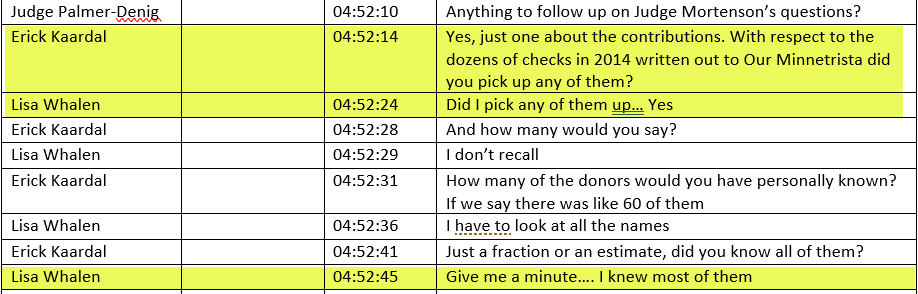
Trial Testimony Exerpt:

Whalen testimony on checks

Minnetristagate judgment affirms violations by Mayor, Councilmembers and “Our Minnetrista” committee

Minnetrista certainly has had its share of controversy over the years but “Minnetristagate” surpasses them all. The political committee “Our Minnetrista” and their candidates violated multiple campaign finance laws in order to influence the 2014 and 2018 Minnetrista city council elections. The financial scheme concocted by the group bypassing Minnesota’s Fair Campaign Practices Act was concealed from the public and according to the final order by the Office of Administrative Hearing’s (OAH) three judge panel:

“…corrupted the political process, and created an unfair advantage for the candidates it supported…”

Our Minnetrista” and its candidates accepted multiple contributions far exceeding statutory limits and then divided them up among their candidates, only reporting a Minnetristagatefraction of the actual check amounts on each candidate’s disclosure reports. They accepted illegal corporate contributions and then reported them as coming from individuals. They had the Westonka School District invoiced for their campaign mailings*, and in the courtroom “I don’t know” was the most frequently heard phrase from Respondents that included Minnetrista Mayor Lisa Whalen, Councilmembers Pam Mortenson and John Tschumperlin, past Councilmember Patricia Thoele, and Our Minnetrista leaders David Kolb and Karen Danielson.

Erick Kaardal, Attorney for Complainant, Shannon Bruce, remarked in his opening statement “How candidates operate in the campaign environment with respect to law reflects on how our public officials act when they are in office. And so, this is a very important case regarding how our campaigns for public officials are going to be operated consistent with the law or in violation of the law.”

Respondents defended their scheme to the very end claiming to have researched its financial structure with the city clerk, Secretary of State’s office and the Campaign Finance Board. Interestingly they didn’t have a single witness from those offices willing to testify on their behalf, provided no evidence such contacts ever occurred and couldn’t remember most of the names of the persons with whom they had allegedly spoken.

A highlight from the two day trial came from Mayor Lisa Whalen who, after being shown two checks, each for $1,000 from the same individual (contribution limit is $600) displaying clear, easily recognizable signatures on each check, feigned she didn’t know who made the contribution because she couldn’t make out the signature. Here are the exhibits she was shown:

Continue reading “Minnetristagate judgment affirms violations by Mayor, Councilmembers and “Our Minnetrista” committee”

WSB Engineering should be accountable for flawed design, not taxpayers

Last night’s council meeting included a proposal from WSB Engineering for engineering design and bidding services related to the repair of the watermain break in Woodland Cove on Kings Point Road that was temporarily fixed last winter. The construction repair costs are estimated at approximately $78,000 plus the WSB fees for engineering, bidding, and project management.

pexels-photo-2068975.jpeg
WSB Engineering should pay for flawed design, not Minnetrista taxpayers.

Councilmember Molitor reminded the council this infrastructure was originally designed by WSB and completed just a few years ago with the start of the Woodland Cove development. He expressed concern that Minnetrista taxpayers shouldn’t have to pay for these repairs caused by what he viewed as a flawed engineering design that led to the watermain break in the first place. He requested that WSB pay for the repairs or negotiate a reasonable settlement with the city.

I wholeheartedly agree. WSB will come back with another proposal next month addressing the matter. Thank you Councilor Molitor for standing up for Minnetrista taxpayers.

“Minnetristagate” Update

MinnetristagateI’ve received a lot of inquiries about the status of the Minnetrista campaign finance violations alleged against Minnetrista’s mayor, 2 sitting and one past councilmember and leaders of the “Our Minnetrista” organization. A three judge panel heard testimony by all the Respondents and Complainant during an evidentiary hearing that lasted two days (May 7 & 8, 2019) at the Minnesota Office of Administrative Hearings in Saint Paul. Closing statements are due today, Friday, June 7, 2019, and a judgement will follow within two weeks.

Why Minnetrista needs a staff city engineer

A 178 page document, written by the city’s contract engineering firm, WSB Engineering, was provided to council members less than 2 business days prior to the council meeting on March 18 where we would be asked to approve the plans and specifications for Minnetrista’s 2019 street improvement projects that will cost the city over $800,000 this year. This Plans & Specifications document lays out the engineering specifications and bidding requirements for the year’s road projects. Would it surprise anyone that this document was never reviewed by a qualified, impartial party?

I asked our legal counsel if he had reviewed the 178 page document and he indicated he had not. I expressed a concern that none of our council members are engineers, qualified to assess whether or not these plans and specifications should be approved, nor do we have anyone on staff qualified to review them (other than WSB, the contractor that wrote them). My concerns were minimalized by our City Administrator who essentially said we should trust our contract engineering firm, WSB, who authored the document, to review it on our behalf. In my opinion, that would be appropriate had they no financial interest in the street improvement projects. But. They. Do.

I voted not to approve the plans and specifications. However, the rest of the council approved them, regardless of their ability to understand them. I wasn’t surprised by this, nor was I surprised that the concerns I voiced during the March 18 council meeting were not mentioned in the meeting minutes. I  requested the minutes be amended to accurately reflect the concerns I raised.

Minnetrista needs a staff city engineer without a financial interest in the engineering projects required by the city. That doesn’t mean we wouldn’t contract with outside engineering companies when necessary. It means we would have confidence our decisions prioritize Minnetrista residents’ interests over city contractors’.


Judgment due mid-June for “Our Minnetrista” candidates

The evidentiary hearing concerning the alleged campaign finance violations of the “Our Minnetrista” organization and the candidates they supported in the 2014 and 2018 elections concluded Wednesday, May 8, 2019. Testimony began the morning of Tuesday, May 7 and was heard by three Administrative Law Judges with the Office of Administrative Hearings in St. Paul, MN. Final arguments to be submitted in writing by both the Complainant and Respondents are due June 7, 2019 and a final judgement will be issued approximately 14 days following.

Audio recording of testimony is available to order from the Office of Administrative Hearings (Case# 71-0325-35774) https://mn.gov/oah/media/media-contacts.jsp